
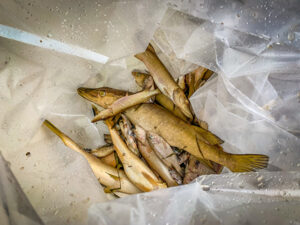
 Officials with the Michigan Department of Environment, Great Lakes, and Energy said a recent fish kill along the southern reaches of the Escanaba River at Gladstone was the result of a pipe failure at Verso Corporation’s Escanaba Paper Mill.
“We have been sampling and monitoring the river at numerous points since this incident occurred,” said Tom Asmus, who monitors compliance with the National Pollutant Discharge Elimination System program for EGLE in the eastern Upper Peninsula. Under the Clean Water Act, the program controls point source discharges of pollutants to waters of the U.S. “All indications are that the environmental conditions in the river have recovered.”
The fish kill, which affected at least a dozen species, was reported Sunday Aug. 9 to EGLE and Michigan Department of Natural Resources personnel, who responded the following day.
Dead fish – including northern pike, bass, walleye and other sportfish – were found by anglers and personnel from the two state agencies downstream of Verso’s paper mill, specifically, from Dam No. 2 to the mouth of the river at Lake Michigan, a distance of roughly 3 miles.
Jay Parent, district supervisor for EGLE’s Water Resources Division, said that prior to the reported fish kill the mill had reported a ruptured pipe had affected the mill’s wastewater treatment. The pipe failure has been repaired and out-flowing water quality has improved.
Asmus said when the pipe failed a “black liquor” was released to the wastewater treatment plant. Black liquor is a high-strength organic pollutant derived from the breakdown of pulpwood.
“The black liquor overwhelmed the facility’s wastewater treatment system causing effluent (outflow) violations,” Asmus said. “The wastewater system remained functional however, it was not capable of treating the black liquor entirely.
“When the high-strength effluent from the wastewater treatment plant reached the river, oxygen was drawn from the river, starving the ecosystem of dissolved oxygen and consequently killing numerous fish.”
There was no reported release of toxic chemicals to the river by Verso.
“Black liquor is a byproduct of a process at the mill, not a chemical purchased and stored on site for a specific purpose,” Asmus said. “It’s typically concentrated at the mill and burned to generate energy.
“The pipe failure caused permit exceedances that will result in violations of the facility’s permit to discharge treated wastewater to the Escanaba River.”
Personnel from EGLE and the DNR’s Fisheries Division are working on a damage assessment to the Escanaba River fishery downstream of Dam No. 2.
“Once the assessments are complete, EGLE will begin enforcement proceedings against Verso, which may include resource compensation to reinvest in the fishery,” Asmus said.
The 52-mile Escanaba River has long been a popular destination for anglers.

Click To Submit Press Releases, News, Calendar Items, and Community Events to mediaBrew radio stations WFXD, WKQS, WRUP, GTO, Fox Sport Marquette, and 106.1 The Sound
Marquette, Michigan Calendar; Ishpeming Calendar; Negaunee Calendar; Gwinn Calendar; Negaunee Calendar and Events; Upper Peninsula Calendar of Events; Escanaba Events and Calendar