

Most people don’t spend much time thinking about firewood. If it’s split and dry, it’s good to go, right?
Well, maybe not. In recognition of Firewood Month, Michigan’s Invasive Species Program is taking a few minutes to unpack some firewood facts to help you make safe firewood choices to protect Michigan’s trees and forests. Heating a home or enjoying a cozy evening by the fire is a great way to repurpose dead trees, but we often don’t think about what killed them.
Invasive insects like emerald ash borer or fungi like oak wilt can kill even healthy trees.
Other trees succumb to environmental conditions like drought, overcrowding or storm damage. Once a tree is weakened, it can become home to a host of insects and fungi that often remain in the wood even after it has been cut. That means dead wood is often alive with harmful insects and diseases that can be transported to new locations on or in firewood.
What’s in my wood?
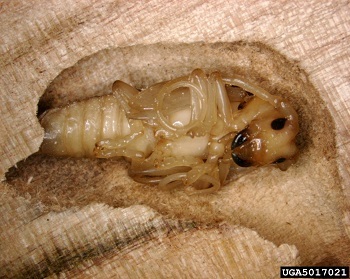 Wood borers Wood borers
“Wood borer” is a general term for beetles that lay eggs on or in the bark of trees. When eggs hatch, these insects spend their larval stages tunneling into and feeding on wood, destroying tissues that move sap and water through the tree. Many wood borers are native and seek out weakened trees. Others, such as invasive emerald ash borer and the Asian longhorned beetle (found in nearby states), infest healthy trees and cause their decline and death. Wood borer eggs and larvae can remain in wood after trees die. Because they often are under bark or within the wood itself, they can go unnoticed until they emerge as adults. A Michigan study of 1,045 firewood pieces transported by the public indicated 23% contained live borers and an additional 41% showed evidence of previous borer infestation. |
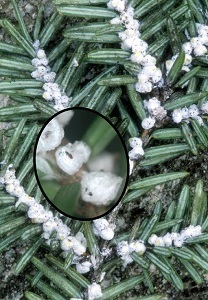 Adelgids Adelgids
Adelgids are small, soft-bodied insects that feed on coniferous plants like pines or firs using piercing/sucking mouthparts. Agencies and partners in Michigan’s Invasive Species Program are working hard to prevent the spread of hemlock woolly adelgid in west Michigan. The Michigan Department of Agriculture and Rural Development is managing balsam woolly adelgid in areas of Clare, Missaukee and Oceana counties. Adelgids are hard to see with the naked eye and are usually detected by the small, white, cottony tufts they spin to protect their eggs. Over time, hemlock and balsam woolly adelgids can kill their host trees by depleting sap and preventing its circulation. |
Fungal diseases
Whether native or invasive, many types of fungi can cause tree death. Fungal diseases move around via spores or other structures and are spread in a variety of ways. Both invasive oak wilt and Dutch elm disease fungal spores can be spread by beetles. When trees die of fungal disease, the fungus can remain alive even if the wood is cut. Moving infected wood can spread tree diseases to areas far beyond a beetle’s range.
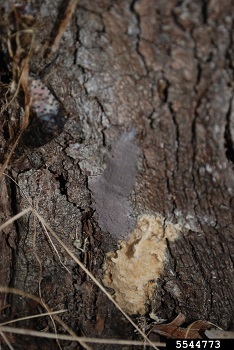 Egg masses Egg masses
For many Michiganders, spongy moths (formerly gypsy moths) and their munching caterpillars are all too familiar. While female moths can’t fly, they easily spread across the state by depositing egg masses on vehicles, outdoor equipment and firewood, which are then moved around by people. With invasive spotted lanternfly now present in areas of southeast Michigan, the same scenario is likely to play out again unless we all take the time to look for and remove egg masses from belongings and adopt safe firewood practices. |
Here’s the takeaway: Don’t take it away!
Wood that looks clean and healthy can harbor tiny insects, eggs or microscopic fungi spores that can start a new and deadly infestation. Always leave your backyard firewood at home, even if you think it looks fine.
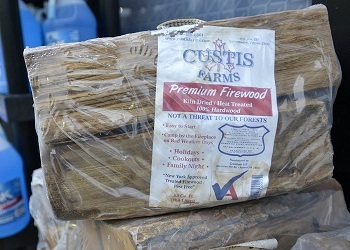
How to keep the fire burning
You can still have a roaring campfire or a cozy night in front of the fireplace if you just know how to burn safely.
|
We’ve got a lot to protect
More than half of our state is forested – with an estimated 14 billion trees! Trees are part of every landscape we enjoy, from fall forest colors to river corridors to shady sidewalks and parks. Making safe firewood choices helps to protect the diversity and health of Michigan’s forest resources.
Learn more about protecting trees from invasive species at DontMoveFirewood.org.
|
|
Michigan’s Invasive Species Program is cooperatively implemented by the Department of Environment, Great Lakes, and Energy; the Department of Natural Resources; and the Department of Agriculture and Rural Development.

Click To Submit Press Releases, News, Calendar Items, and Community Events to mediaBrew radio stations WFXD, WKQS, WRUP, GTO, Fox Sport Marquette, and 106.1 The Sound
Marquette, Michigan Calendar; Ishpeming Calendar; Negaunee Calendar; Gwinn Calendar; Negaunee Calendar and Events; Upper Peninsula Calendar of Events; Escanaba Events and Calendar